

Not long ago, Professor Marinka Zitnik's team from the Department of Biomedical Informatics at Harvard Medical School published a forward-looking article in the journal Cell entitled "Empowering biomedical discovery with AI agents," proposing a new concept of "AI scientists." This concept aims to drive a revolution in biomedical research by integrating artificial intelligence models with biomedical tools to create intelligent systems capable of reflective learning and reasoning.
[Research Background]
For a long time, the field of artificial intelligence has been committed to developing AI systems capable of autonomously making significant scientific discoveries, learning on their own, and acquiring knowledge. However, this goal has always been quite challenging. With the development of agent-based artificial intelligence technology, it has become possible to build AI agent systems capable of reflective learning and reasoning. These systems can coordinate resources such as large language models (LLMs), machine learning tools, and experimental platforms to address the decomposition and resolution of complex problems in biomedical research.
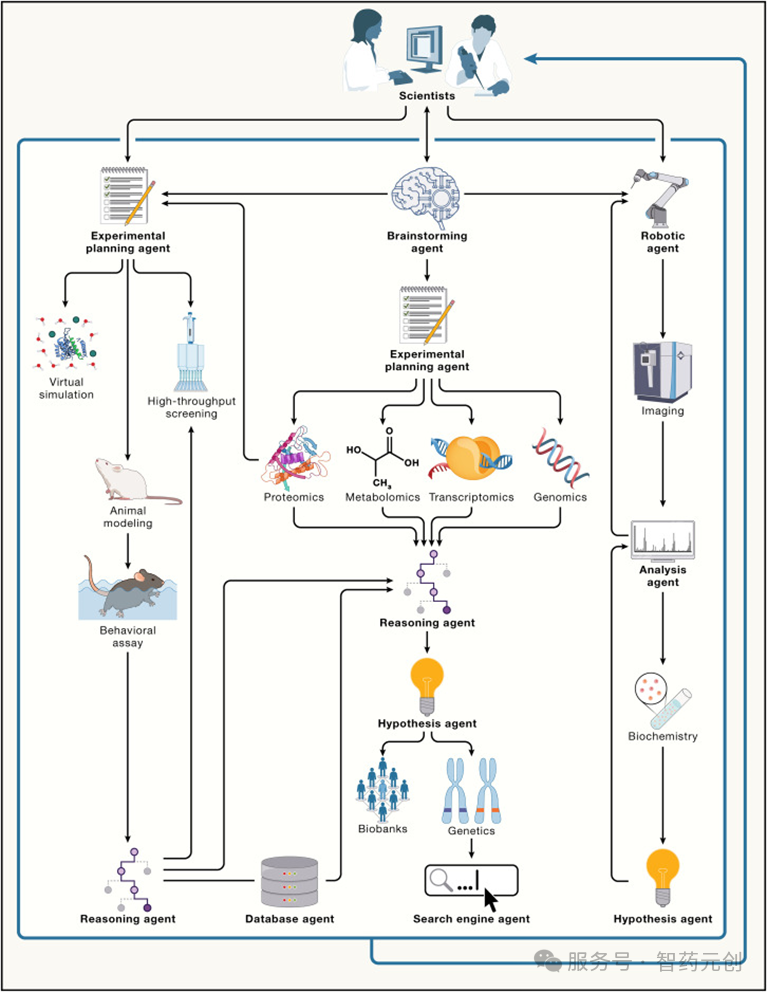
[Article Core: Definition and Vision of "AI Scientists"]
The article elucidates the core concept of "AI scientists," which involves breaking down complex biomedical problems into manageable subtasks and assigning them to agents with specific functions to solve, thereby integrating scientific knowledge and addressing targeted problems. These AI agents are not intended to replace the human role in the discovery process, but rather to combine human creativity and expertise with AI's ability to analyze large datasets, explore hypothesis spaces, and perform repetitive tasks. AI agents can leverage large language and generative models to build structured memories for continuous learning and incorporate scientific knowledge, biological principles, and theories using machine learning tools.
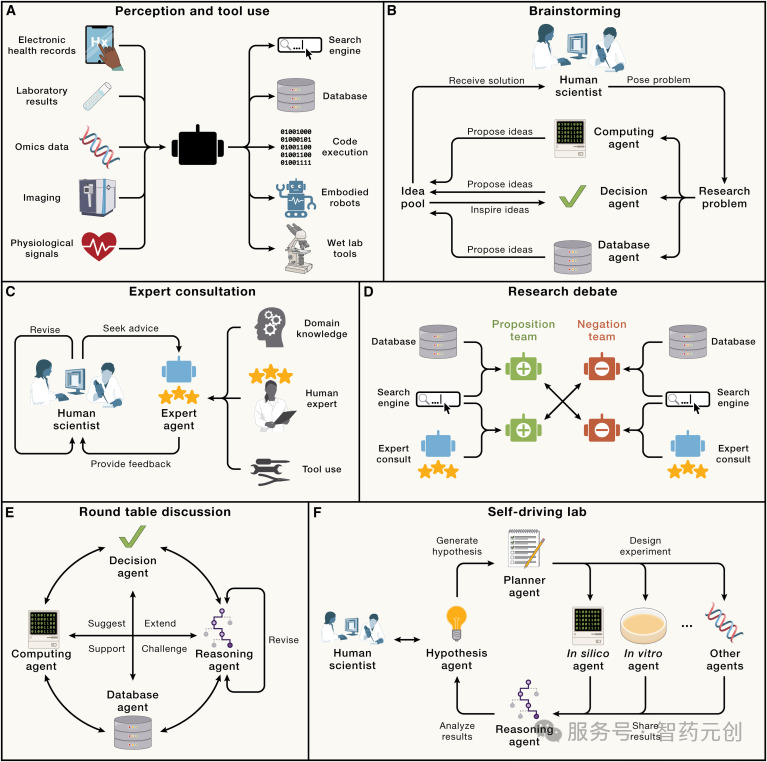
The core competencies of an "AI scientist"
- Reflective learning and reasoning
"AI scientists" can collaborate with humans and other AI systems through dialogue, engaging in reflective learning and reasoning. This ability allows them to flexibly break down tasks in complex biological problems and address them in a targeted manner through specialized AI agents. The article mentions that "AI scientists" can identify knowledge gaps through self-assessment and continuously optimize their knowledge base through ongoing learning.
- Multimodal learning and generative models
AI scientists utilize large language models (LLMs) and generative models, combining scientific knowledge, biological principles, and theories, to continuously learn. This capability enables AI scientists to play a crucial role in fields such as virtual cell simulation, phenotypic programming control, cell circuit design, and the development of new therapies.
- Automation and efficiency
AI scientists can automate repetitive tasks and analyze massive datasets, navigating hypothesis spaces with scale and precision that surpasses that of human researchers. This automation enables AI scientists to conduct continuous, high-throughput research that is impossible for human researchers operating alone. For example, AI scientists can rapidly generate hypotheses and validate their validity through high-throughput screening and virtual experiments.
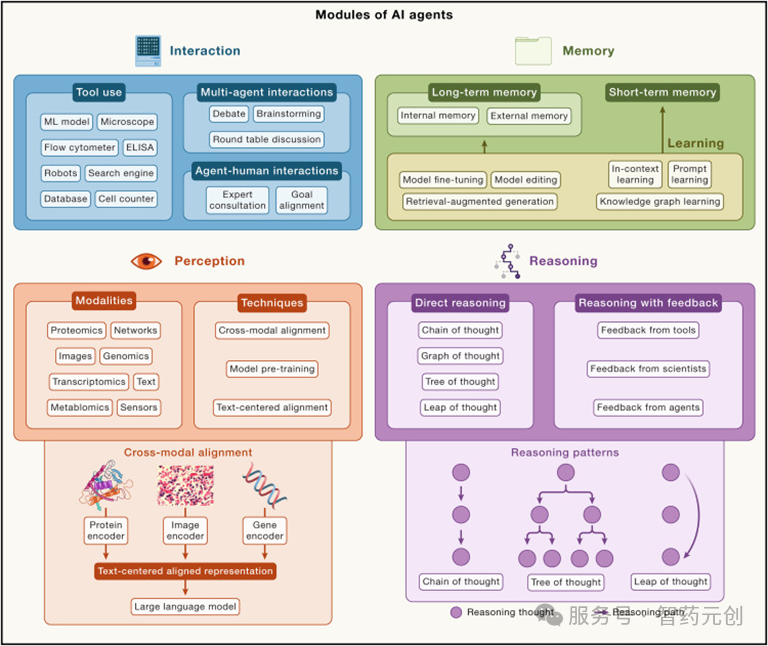
Four AI Agent Systems with Different Levels of Autonomy
- Level 0: No AI Agent, only machine learning models are used as tools.
- Level 1: The AI Agent acts as a research assistant, performing tasks defined by scientists.
- Level 2: AI agents, as collaborators, are able to use a wide range of tools for scientific discovery, but their hypothesis generation capabilities are limited.
- Level 3: The AI Agent acts as a scientist, capable of generating innovative hypotheses and designing experiments autonomously.
The research team demonstrated the application of the AI Agent system in genetics, cell biology, and chemical biology through multiple case studies. For example, in genetics research, the AI Agent can perform genome-wide association studies (GWAS) to identify disease-related gene variants; in cell biology, the AI Agent can predict drug resistance mechanisms and optimize experimental design; and in chemical biology, the AI Agent can design new drug molecules and conduct experimental validation.
[Ethics and Challenges]
While AI scientists have demonstrated immense potential in biomedical research, their application also brings a series of ethical and challenges. The article mentions that AI scientists' alterations to the environment using machine learning tools or by accessing experimental platforms may pose risks, necessitating safety measures to prevent harm. Furthermore, a key challenge for biomedical AI scientists is the lack of large-scale, diverse experimental datasets, which limits their ability to generalize to new tasks and acquire new skills.
[Future Outlook]
The article points out that the development of "AI scientists" will propel biomedical research into a new era. By constructing trustworthy sandbox environments, "AI scientists" can experience failures and learn from them, thereby achieving continuous progress. Future research directions include improving the robustness and reliability of "AI scientists," developing comprehensive governance frameworks, and ensuring that the behavior of "AI scientists" complies with ethical and safety standards.
AI scientists, as a new engine for biomedical research, are changing our understanding and practice of scientific discovery. By integrating human creativity and expertise with the powerful analytical capabilities of AI, AI scientists are expected to play an increasingly important role in future biomedical research. However, we also need to carefully address the ethical and ethical challenges they bring to ensure that the application of AI scientists truly benefits human health.
References:
Gao, S., Fang, A., Huang, Y., Giunchiglia, V., Noori, A., Schwarz, J. R., ... & Zitnik, M. (2024). Empowering biomedical discovery with AI agents. Cell, 187(10), 6125-6151. https://doi.org/10.1016/j.cell.2024.09.022

 WeChat Customer Service